
Publications
Below are my publications and preprints, each with links, an abstract, a short plain-language summary, and a BibTeX entry; use the filter to narrow by type, or download every reference as a single .bib file. See also my Google Scholar profile.
Filter
Publications
2026
[14]
On Tree-Network Distinguishability and Full Identifiability of Phylogenetic Networks
Jari Brits,
Niels Holtgrefe,
Leo van Iersel,
Samuel Martin
In plain language
Before you can reconstruct an evolutionary network from DNA, the data has to pin the network down in the first place. Earlier work established this for level-1 networks only generically, which left a thin set of parameter values where it might still fail. This paper closes that gap under the Jukes-Cantor and Kimura models, showing the network is determined at every biologically sensible choice of parameters. It also proves that a genuine network and a tree essentially never produce the same DNA patterns, so reticulate evolution leaves a signature that can be detected.
Abstract
Phylogenetic networks generalize phylogenetic trees to evolutionary histories that include reticulate events such as recombination, horizontal gene transfer, and hybridization. Under a Markov model of nucleotide substitution, a phylogenetic network determines a distribution of leaf-patterns. Here, we study the identifiability of the network topology from this distribution under the Jukes-Cantor (JC), Kimura 2-parameter (K2P), and Kimura 3-parameter (K3P) models. Our first result is that the semi-directed network parameter of a level-1 phylogenetic network (modulo redirecting triangles) is fully identifiable under all three models, on a biologically reasonable parameter space in which substitution rates are probabilistic and mixing parameters are non-trivial (i.e., not 0 or 1). In contrast to the generic identifiability established in prior work, this holds at every point of the parameter space, not merely off of a measure-zero subset. Our second result distinguishes phylogenetic networks from phylogenetic trees, on the same parameter space, under JC and K2P. We prove that no phylogenetic network and phylogenetic tree can induce the same leaf-pattern distribution unless the network is a tree, possibly augmented with certain substructures called \(2\)-blobs. This means the presence of reticulate evolution creates, in most cases, a detectable signature in the leaf-pattern distribution. More broadly, these results have consequences for identifiability beyond the models and network classes studied here, including for several coalescent-based models.
@misc{brits2026full-identifiability,
author = {Brits, Jari and Holtgrefe, Niels and van Iersel, Leo and Martin, Samuel},
title = {{On Tree-Network Distinguishability and Full Identifiability of Phylogenetic Networks}},
archivePrefix = {arXiv},
eprint = {2607.12919},
year = {2026}
}
[13]
Algebraic Invariants for Inferring 4-leaf Semi-Directed Phylogenetic Networks
Samuel Martin,
Niels Holtgrefe,
Vincent Moulton,
Richard M. Legget
In plain language
Building large evolutionary networks by combining tiny four-species pieces only works if we can infer those pieces reliably. This paper develops an algebra-based method to infer four-leaf networks directly from DNA, measures how much sequence data it needs, and applies it to real fish (Xiphophorus) data.
Abstract
A core goal of phylogenomics is to determine the evolutionary history of a set of species from biological sequence data. Phylogenetic networks are able to describe more complex evolutionary phenomena than phylogenetic trees but are more difficult to accurately reconstruct. Recently, there has been growing interest in developing methods to infer semi-directed phylogenetic networks. As computing such networks can be computationally intensive, one approach to building such networks is to puzzle together smaller networks. Thus, it is essential to have robust methods for inferring semi-directed phylogenetic networks on small numbers of taxa. In this paper, we investigate an algebraic method for performing phylogenetic network inference from nucleotide sequence data on 4-leaf semi-directed phylogenetic networks by analysing the distribution of leaf-pattern probabilities. On simulated data, we found that we can correctly identify with high accuracy the undirected phylogenetic network for sequences of length at least 10kbp. We found that identifying the semi-directed network is more challenging and requires sequences of length approaching 10Mbp. We are also able to use our approach to identify tree-like evolution and determine the underlying tree. Finally, we employ our method on a real dataset from Xiphophorus species and use the results to build a phylogenetic network.
@article{martin2026algebraic-invariants,
author = {Martin, Samuel and Holtgrefe, Niels and Moulton, Vincent and Legget, Richard M},
title = {{Algebraic Invariants for Inferring 4-leaf Semi-Directed Phylogenetic Networks}},
journal = {Systematic Biology},
volume = {75},
number = {4},
pages = {657-672},
doi = {10.1093/sysbio/syaf071},
year = {2026}
}
[12]
PhyloZoo: a unified framework for phylogenetic network analysis in Python
Niels Holtgrefe
In plain language
Software for studying phylogenetic networks is usually tied to one specific inference method and hard to combine with other tools. PhyloZoo is an open-source Python framework that provides shared building blocks — data structures, visualization, and file handling — for working with many kinds of evolutionary network in one place. It makes reproducible, interoperable network analysis much easier to build on.
Abstract
Reticulate evolutionary processes (events in which lineages merge, such as hybridization, recombination, and horizontal gene transfer) are widespread across nature but cannot be represented by phylogenetic trees alone. Phylogenetic networks have therefore become an important modelling tool, yet existing software is typically tied to specific inference paradigms and provides limited support for working with multiple network representations in a unified and programmable environment. PhyloZoo is an open-source Python framework that lowers the barrier to developing practical, easy-to-use software for phylogenetic network analysis. It provides data structures and algorithms covering the main representations used in the field, together with dedicated visualization tools and robust I/O for all major phylogenetic file formats. A particular emphasis lies on semi-directed phylogenetic networks, which explicitly represent root uncertainty and have so far received limited support in existing software. By offering a shared foundation for developing interoperable tools and a combinatorial layer that supports computational proofs and theoretical exploration, PhyloZoo enables reproducible workflows for applied, methodological, and theoretical studies of reticulate evolution. Availability and implementation: PhyloZoo is implemented in Python and installable from PyPI, with source code, documentation, and examples available at https://github.com/nholtgrefe/phylozoo.
@misc{holtgrefe2026phylozoo,
author = {Holtgrefe, Niels},
title = {{PhyloZoo: a unified framework for phylogenetic network analysis in Python}},
archivePrefix = {bioRxiv},
eprint = {10.64898/2026.06.09.731120},
year = {2026}
}
[11]
Tractable Maximization of Budgeted Phylogenetic Diversity on Networks Utilizing Node Scanwidth
Niels Holtgrefe,
Jannik Schestag
In plain language
Deciding which species to protect to preserve the most evolutionary diversity gets much harder when protection has real, uneven costs and evolution is network-shaped rather than tree-shaped. This paper gives fast algorithms for several budgeted versions of that problem by exploiting a "tree-likeness" measure of the network called node scanwidth, and also shows how to compute that measure exactly. In experiments the methods handle networks with hundreds of species in a fraction of a second, and remain practical even up to a thousand species.
Abstract
Identifying a subset of taxa that maximizes Phylogenetic Diversity (PD) is a cornerstone of quantitative conservation planning. Traditionally, PD is defined over a phylogenetic tree in which leaves represent present-day taxa and branch lengths capture the estimated evolutionary distinctiveness. While PD maximization is computationally tractable on trees with unit costs, the problem becomes NP-hard when transitioning to phylogenetic networks or to budgeted versions in which protecting taxa incurs non-homogeneous costs.
In this paper, we address these two challenges by providing definitions and a comprehensive analysis of three distinct variants of budgeted PD on networks. We conduct our study through the lens of a small structural parameter, node scanwidth (nsw), which measures the tree-likeness of a phylogenetic network. We show that two of the considered variants can be optimized in \(\mathcal{O}^*(2^{\mathsf{nsw}} \cdot B^2)\) time, where \(B\) is the budget. For the computationally harder, third variant, we provide an algorithm to compute PD scores in \(\mathcal{O}^*(3^{\mathsf{nsw}})\) time.
We further contribute the first exact algorithms to compute node scanwidth, recognizing that the utility of algorithms based on nsw depends on the ability to compute nsw and its corresponding decomposition. Our approaches integrate data reduction rules, dynamic programming, and an Integer Linear Programming formulation.
We validate our theoretical results through extensive experiments on highly reticulated, simulated networks containing several hundred taxa, using heterogeneous costs. Our implementation computes PD scores and optimal nsw in fractions of a second, even on the most challenging instances. Furthermore, our budgeted optimization algorithms significantly outperform existing benchmarks for computing PD on networks, which were previously limited to unit-cost scenarios. The software makes analyses even on networks with a thousand taxa tractable in practice.
@misc{holtgrefe2026budgeted-pd,
author = {Holtgrefe, Niels and Schestag, Jannik},
title = {{Tractable Maximization of Budgeted Phylogenetic Diversity on Networks Utilizing Node Scanwidth}},
archivePrefix = {arXiv},
eprint = {2605.23319},
year = {2026}
}
[10]
Bounds on the Sequence Length Sufficient to Reconstruct Binary Level-1 Phylogenetic Networks Under the CFN Model
Martin Frohn,
Niels Holtgrefe,
Leo van Iersel,
Mark Jones,
Steven Kelk
In plain language
Existing methods can reconstruct certain evolutionary networks correctly if given infinitely long DNA sequences, but real data is finite. This paper works out how long the sequences actually need to be to recover the right network with high probability under the CFN model, showing that the requirement grows manageably with the number of species, at a rate that is logarithmic, polylogarithmic, or polynomial depending on the parameter regime.
Abstract
Phylogenetic trees and networks are graphs used to model evolutionary relationships, with trees representing strictly branching histories and networks allowing for
events in which lineages merge, called reticulation events.
While the question of data sufficiency has been studied extensively in the context of trees, it remains largely unexplored for networks. In this work we take a first step in this direction
by establishing bounds on the amount of genomic data required to reconstruct binary level-1 semi-directed phylogenetic networks, which are binary networks in which reticulation events are indicated by directed edges, all other edges are undirected, and cycles are vertex-disjoint. For this class, methods have been developed recently that are statistically consistent. Roughly speaking, such methods are guaranteed to reconstruct the correct network assuming infinitely long genomic sequences. Here we consider the question whether networks from this class can be uniquely and correctly reconstructed from finite sequences.
Specifically, we present an inference algorithm that takes as input genetic sequence data, and demonstrate that the sequence length sufficient to reconstruct the correct network with high probability,
under the CFN model of evolution, scales logarithmically, polynomially, or polylogarithmically with the number of taxa, depending on the parameter regime. As part of our contribution, we also present novel inference rules for quartet data in the semi-directed phylogenetic network setting.
@article{frohn2026sequence-bounds,
author = {Frohn, Martin and Holtgrefe, Niels and van Iersel, Leo and Jones, Mark and Kelk, Steven},
title = {{Bounds on the Sequence Length Sufficient to Reconstruct Binary Level-1 Phylogenetic Networks Under the CFN Model}},
journal = {Annals of Combinatorics},
doi = {10.1007/s00026-026-00830-0},
year = {2026}
}
[9]
Exact and Heuristic Computation of the Scanwidth of Directed Acyclic Graphs
Niels Holtgrefe,
Leo van Iersel,
Mark Jones
In plain language
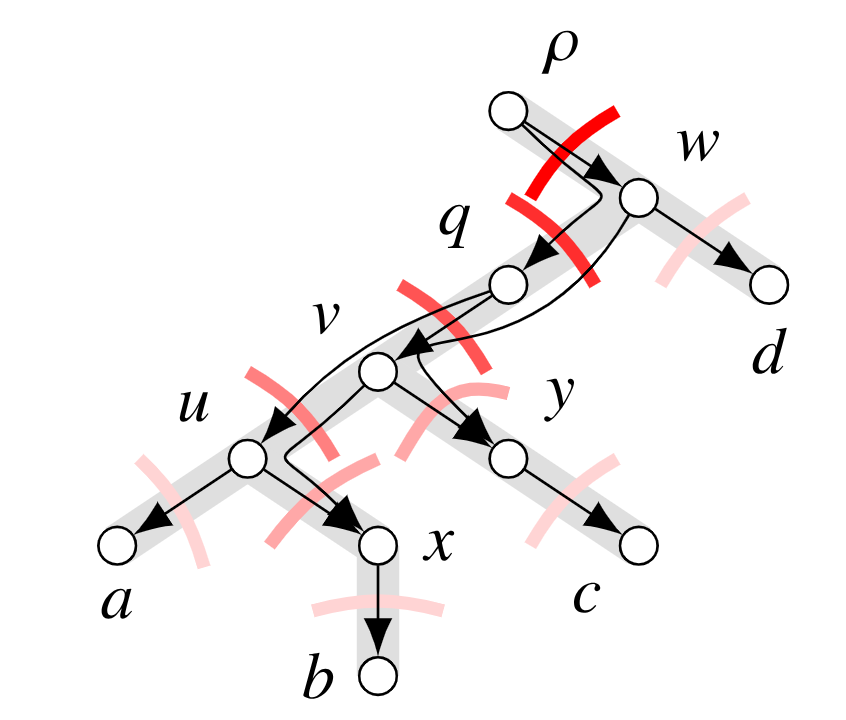
Many hard computational problems on evolutionary networks become easy when the network has a simple enough shape, measured by a number called its scanwidth. To take advantage of this you first have to compute that number, which was previously impractical. This paper gives the first efficient algorithm that computes scanwidth exactly, together with a fast heuristic that comes close to optimal on real datasets.
Abstract
To measure the tree-likeness of a directed acyclic graph (DAG), a new width parameter that considers the directions of the arcs was recently introduced: scanwidth. We present the first algorithm that efficiently computes the exact scanwidth of general DAGs. For DAGs with one root and scanwidth \( k \), it runs in \( O(k \cdot n^k \cdot m) \) time. The algorithm also functions as an FPT algorithm with complexity \( O(2^{4\ell - 1} \cdot \ell \cdot n + n^2) \) for phylogenetic networks of level-\( \ell \), a type of DAG used to depict evolutionary relationships among species. Our algorithm performs well in practice, being able to compute the scanwidth of synthetic networks up to 30 reticulations and 100 leaves within 500 seconds. Furthermore, we propose a heuristic that obtains an average practical approximation ratio of 1.5 on these networks. While we prove that the scanwidth is bounded from below by the treewidth of the underlying undirected graph, experiments suggest that for networks the parameters are close in practice.
@article{holtgrefe2026scanwidth-exact,
author = {Holtgrefe, Niels and van Iersel, Leo and Jones, Mark},
title = {{Exact and Heuristic Computation of the Scanwidth of Directed Acyclic Graphs}},
journal = {Journal of Computer and System Sciences},
volume = {160},
pages = {103802},
doi = {10.1016/j.jcss.2026.103802},
year = {2026}
}
[8]
Limits of Kernelization and Parametrization for Phylogenetic Diversity with Dependencies
Niels Holtgrefe,
Jannik Schestag,
Norbert Zeh
In plain language
Choosing species to conserve becomes more realistic when we insist that a saved predator also has some saved prey, a dependency captured by a food web. This paper maps out when this constrained problem can be solved efficiently and, importantly, proves hard limits: for many natural ways of measuring the input's complexity, the problem provably cannot be "compressed" to a small equivalent instance before solving.
Abstract
In the Maximize Phylogenetic Diversity problem, we are given a phylogenetic tree that represents the genetic proximity of species, and we are asked to select a subset of species of maximum phylogenetic diversity to be preserved through conservation efforts, subject to budgetary constraints that allow only \( k \) species to be saved. This neglects that it is futile to preserve a predatory species if we do not also preserve at least a subset of the prey it feeds on. Thus, in the Optimizing PD with Dependencies (\( \varepsilon \)-PDD) problem, we are additionally given a food web that represents the predator–prey relationships between species. The goal is to save a set of \( k \) species of maximum phylogenetic diversity such that for every saved species, at least one of its prey is also saved. This problem is NP-hard even when the phylogenetic tree is a star.
The \( \alpha \)-PDD problem alters \( \varepsilon \)-PDD by requiring that at least some fraction \( \alpha \) of the prey of every saved species are also saved. In this paper, we study the parameterized complexity of \( \alpha \)-PDD. We prove that the problem is W[1]-hard and in XP when parameterized by the solution size \( k \), the diversity threshold \( D \), or their complements. When parameterized by the vertex cover number of the food web, \( \alpha \)-PDD is fixed-parameter tractable (FPT). A key measure of the computational difficulty of a problem that is FPT is the size of the smallest kernel that can be obtained. We prove that, when parameterized by the distance to clique, 1-PDD admits a linear kernel. Our main contribution is to prove that \( \alpha \)-PDD does not admit a polynomial kernel when parameterized by the vertex cover number plus the diversity threshold \( D \), even if the phylogenetic tree is a star. This implies the non-existence of a polynomial kernel for \( \alpha \)-PDD also when parameterized by a range of structural parameters of the food web, such as its distance to cluster, treewidth, pathwidth, feedback vertex set, and others.
@misc{holtgrefe2026kernelization-pd,
author = {Holtgrefe, Niels and Schestag, Jannik and Zeh, Norbert},
title = {{Limits of Kernelization and Parametrization for Phylogenetic Diversity with Dependencies}},
archivePrefix = {arXiv},
eprint = {2602.12959},
year = {2026}
}
[7]
Characterizing semi-directed phylogenetic networks and their multi-rootable variants
Niels Holtgrefe,
Katharina T. Huber,
Leo van Iersel,
Mark Jones,
Vincent Moulton
In plain language
Semi-directed networks are a popular way to depict evolution when the ancient "root" cannot be pinned down but individual merging events can. Their usual definition is indirect: it does not tell you, just by looking, whether a given diagram is a valid one. This paper gives explicit, checkable characterizations of these networks (and a multi-root variant), and connects them to well-known families of evolutionary networks.
Abstract
In evolutionary biology, phylogenetic networks are graphs that provide a flexible framework for representing complex evolutionary histories that involve reticulate evolutionary events. Recently phylogenetic studies have started to focus on a special class of such networks called semi-directed networks. These graphs are defined as mixed graphs that can be obtained by de-orienting some of the arcs in some rooted phylogenetic network, that is, a directed acyclic graph whose leaves correspond to a collection of species and that has a single source or root vertex. However, this definition of semi-directed networks is implicit in nature since it is not clear when a mixed-graph enjoys this property or not. In this paper, we introduce novel, explicit mathematical characterizations of semi-directed networks, and also multi-semi-directed networks, that is, mixed graphs that can be obtained from directed phylogenetic networks that may have more than one root. In addition, through extending foundational tools from the theory of rooted networks into the semi-directed setting---such as cherry picking sequences, omnians, and path partitions---we characterize when a (multi-)semi-directed network can be obtained by de-orienting some rooted network that is contained in one of the well-known classes of tree-child, orchard, tree-based or forest-based networks. These results address structural aspects of (multi-)semi-directed networks and pave the way to improved theoretical and computational analyses of such networks, for example, within the development of algebraic evolutionary models that are based on such networks.
@article{holtgrefe2026characterizing-sd,
author = {Holtgrefe, Niels and Huber, Katharina T and van Iersel, Leo and Jones, Mark and Moulton, Vincent},
title = {{Characterizing semi-directed phylogenetic networks and their multi-rootable variants}},
journal = {Theory in Biosciences},
volume = {145},
number = {1},
pages = {4},
doi = {10.1007/s12064-025-00453-8},
year = {2026}
}
2025
[6]
PaNDA: Efficient Optimization of Phylogenetic Diversity in Networks
Niels Holtgrefe,
Leo van Iersel,
Ruben Meuwese,
Yukihiro Murakami,
Jannik Schestag
In plain language
When conservation budgets force us to protect only some species, which ones preserve the most evolutionary variety? On simple evolutionary trees this is easy, but on networks, which capture events like hybridization, it becomes computationally hard. PaNDA is an interactive tool built around a new algorithm that solves this diversity-maximization problem efficiently for many realistic networks.
Abstract
Phylogenetic diversity plays an important role in biodiversity, conservation, and evolutionary studies by measuring the diversity of a set of taxa based on their phylogenetic relationships. In phylogenetic trees, a subset of \( k \) taxa with maximum phylogenetic diversity can be found by a simple and efficient greedy algorithm. However, this algorithmic tractability is lost when considering phylogenetic networks, which incorporate reticulate evolutionary events such as hybridization and horizontal gene transfer. To address this challenge, we introduce PaNDA (Phylogenetic Network Diversity Algorithms), the first software package and interactive graphical user-interface for exploring, visualizing and maximizing diversity in phylogenetic networks. PaNDA includes a novel algorithm to find a subset of \( k \) taxa with maximum diversity, running in polynomial time for networks of bounded scanwidth, a measure of tree-likeness of a network that grows slower than the well-known level measure. This algorithm considers the variant of phylogenetic diversity on networks in which the branch lengths of all paths from the root to the selected taxa contribute towards their diversity. We demonstrate the scalability of this algorithm on simulated networks, successfully analyzing level-15 networks with up to 200 taxa in seconds. We also provide a proof-of-concept analysis using a phylogenetic network on Xiphophorus species, illustrating how the tool can support diversity studies based on real genomic data. The software is easily installable and freely available at https://github.com/nholtgrefe/panda. Additionally, we extend the definition of phylogene- tic diversity to semi-directed phylogenetic networks, which are mixed graphs increasingly used in phylogenetic analysis to model uncertainty of the root location. We prove that finding a subset of k taxa with maximum diversity remains NP-hard on semi-directed networks, but do present a polynomial-time algorithm for networks with bounded level.
@misc{holtgrefe2025panda,
author = {Holtgrefe, Niels and van Iersel, Leo and Meuwese, Ruben and Murakami, Yukihiro and Schestag, Jannik},
title = {{PaNDA: Efficient Optimization of Phylogenetic Diversity in Networks}},
archivePrefix = {bioRxiv},
eprint = {10.1101/2025.11.14.688467},
year = {2025}
}
[5]
Distinguishing Phylogenetic Level-2 Networks with Quartets and Inter-Taxon Quartet Distances
Niels Holtgrefe,
Elizabeth S. Allman,
Hector Baños,
Leo van Iersel,
Vincent Moulton,
John A. Rhodes,
Kristina Wicke
In plain language
Two different evolutionary networks can sometimes produce exactly the same observable data, which makes them impossible to tell apart. This work pins down precisely which of the more complex "level-2" networks can be distinguished from four-species snapshots of the data, and derives a distance between species that opens the door to reliably inferring these networks in the future.
Abstract
The inference of phylogenetic networks, which model complex evolutionary processes including hybridization and gene flow, remains a central challenge in evolutionary biology. Until now, statistically consistent inference methods have been limited to phylogenetic level-1 networks, which allow no interdependence between reticulate events. In this work, we establish the theoretical foundations for a statistically consistent inference method for a much broader class: semi-directed level-2 networks that are outer-labeled planar and galled. We precisely characterize the features of these networks that are distinguishable from the topologies of their displayed quartet trees. Moreover, we prove that an inter-taxon distance derived from these quartets is circular decomposable, enabling future robust inference of these networks from quartet data, such as concordance factors obtained from gene tree distributions under the Network Multispecies Coalescent model. Our results also have novel identifiability implications across different data types and evolutionary models, applying to any setting in which displayed quartets can be distinguished.
@article{holtgrefe2025distinguishing-level2,
author = {Holtgrefe, Niels and Allman, Elizabeth S and Baños, Hector and van Iersel, Leo and Moulton, Vincent and Rhodes, John A and Wicke, Kristina},
title = {{Distinguishing Phylogenetic Level-2 Networks with Quartets and Inter-Taxon Quartet Distances}},
journal = {Bulletin of Mathematical Biology},
volume = {87},
number = {12},
pages = {168},
doi = {10.1007/s11538-025-01549-4},
year = {2025}
}
[4]
Identifiability of Phylogenetic Level-2 Networks under the Jukes-Cantor Model
Aviva K. Englander,
Martin Frohn,
Elizabeth Gross,
Niels Holtgrefe,
Leo van Iersel,
Mark Jones,
Seth Sullivant
In plain language
Before trying to reconstruct an evolutionary network, one should check whether the DNA data even determines it uniquely, because otherwise no method can succeed. This paper proves that a broad new class of networks (allowing certain intertwined merging events) is in principle recoverable from DNA under standard models of evolution, extending what was previously known only for simpler networks.
Abstract
We consider the fundamental question of which evolutionary histories can potentially be reconstructed from sufficiently long DNA sequences, by studying the identifiability of phylogenetic networks from data generated under Markov models of DNA evolution. This topic has previously been studied for phylogenetic trees and for phylogenetic networks that are level-1, which means that reticulate evolutionary events were restricted to be independent in the sense that the corresponding cycles in the network are non-overlapping.
In this paper, we study the identifiability of phylogenetic networks from DNA sequence data under Markov models of DNA evolution for more general classes of networks that may contain pairs of tangled reticulations. Our main result is generic identifiability, under the Jukes-Cantor model, of binary semi-directed level-2 phylogenetic networks that satisfy two additional conditions called triangle-free and strongly tree-child.
We also consider level-1 networks and show stronger identifiability results for this class than what was known previously. In particular, we show that the number of reticulations in a level-1 network is identifiable under the Jukes-Cantor model.
Moreover, we prove general identifiability results that do not restrict the network level at all and hold for the Jukes-Cantor as well as for the Kimura-2-Parameter model. We show that any two binary semi-directed phylogenetic networks are distinguishable if they do not display exactly the same 4-leaf subtrees, called quartets. This has direct consequences regarding the blobs of a network, which are its reticulated components. We show that the tree-of-blobs of a network, the global branching structure of the network, is always identifiable, as well as the circular ordering of the subnetworks around each blob, for networks in which edges do not cross and taxa are on the outside.
In this paper, we study the identifiability of phylogenetic networks from DNA sequence data under Markov models of DNA evolution for more general classes of networks that may contain pairs of tangled reticulations. Our main result is generic identifiability, under the Jukes-Cantor model, of binary semi-directed level-2 phylogenetic networks that satisfy two additional conditions called triangle-free and strongly tree-child.
We also consider level-1 networks and show stronger identifiability results for this class than what was known previously. In particular, we show that the number of reticulations in a level-1 network is identifiable under the Jukes-Cantor model.
Moreover, we prove general identifiability results that do not restrict the network level at all and hold for the Jukes-Cantor as well as for the Kimura-2-Parameter model. We show that any two binary semi-directed phylogenetic networks are distinguishable if they do not display exactly the same 4-leaf subtrees, called quartets. This has direct consequences regarding the blobs of a network, which are its reticulated components. We show that the tree-of-blobs of a network, the global branching structure of the network, is always identifiable, as well as the circular ordering of the subnetworks around each blob, for networks in which edges do not cross and taxa are on the outside.
@misc{englander2025identifiability-level2,
author = {Englander, Aviva K and Frohn, Martin and Gross, Elizabeth and Holtgrefe, Niels and van Iersel, Leo and Jones, Mark and Sullivant, Seth},
title = {{Identifiability of Phylogenetic Level-2 Networks under the Jukes-Cantor Model}},
archivePrefix = {bioRxiv},
eprint = {10.1101/2025.04.18.649493},
year = {2025}
}
[3]
Reconstructing semi-directed level-1 networks using few quarnets
Martin Frohn,
Niels Holtgrefe,
Leo van Iersel,
Mark Jones,
Steven Kelk
In plain language
A large evolutionary network can be rebuilt from its four-species sub-pieces, but querying every possible group of four species is wasteful. This paper gives a fast algorithm that reconstructs the whole network using only a near-minimal number of these four-species pieces, and even recovers the network's coarse skeleton in more general settings.
Abstract
Semi-directed networks are partially directed graphs that model evolution where the directed edges represent reticulate evolutionary events. We present an algorithm that reconstructs binary \(n\)-leaf semi-directed level-1 networks in \( O( n^2) \) time from its quarnets (4-leaf subnetworks). Our method assumes we have direct access to all quarnets, yet uses only an asymptotically optimal number of \( O(n \log n) \) quarnets. When the network is assumed to contain no triangles, our method instead relies only on four-cycle quarnets and the splits of the other quarnets. A variant of our algorithm works with quartets rather than quarnets and we show that it reconstructs most of a semi-directed level-1 network from an asymptotically optimal \( O(n \log n) \) of the quartets it displays. Additionally, we provide an \( O(n^3) \) time algorithm that reconstructs the tree-of-blobs of any binary \( n\)-leaf semi-directed network with unbounded level from \( O(n^3) \) splits of its quarnets.
@article{frohn2025few-quarnets,
author = {Frohn, Martin and Holtgrefe, Niels and van Iersel, Leo and Jones, Mark and Kelk, Steven},
title = {{Reconstructing semi-directed level-1 networks using few quarnets}},
journal = {Journal of Computer and System Sciences},
volume = {152},
pages = {103655},
doi = {10.1016/j.jcss.2025.103655},
year = {2025}
}
[2]
Squirrel: Reconstructing Semi-directed Phylogenetic Level-1 Networks from Four-Leaved Networks or Sequence Alignments
Niels Holtgrefe,
Katharina T. Huber,
Leo van Iersel,
Mark Jones,
Samuel Martin,
Vincent Moulton
@article{holtgrefe2025squirrel,
author = {Holtgrefe, Niels and Huber, Katharina T and van Iersel, Leo and Jones, Mark and Martin, Samuel and Moulton, Vincent},
title = {{Squirrel: Reconstructing Semi-directed Phylogenetic Level-1 Networks from Four-Leaved Networks or Sequence Alignments}},
journal = {Molecular Biology and Evolution},
volume = {42},
number = {4},
pages = {msaf067},
doi = {10.1093/molbev/msaf067},
year = {2025}
}
2024
[1]
Invariants for level-1 phylogenetic networks under the random walk 4-state Markov model
Martin Frohn,
Niels Holtgrefe,
Leo van Iersel,
Mark Jones,
Steven Kelk
In plain language
Certain polynomial equations, called invariants, act as fingerprints that a stretch of DNA evolved along a particular network. This paper works out these fingerprints for a family of simple cyclic networks under a general model of DNA change, and gives a faster, more reliable way to find them, while also showing they are not quite enough to tell all four-species networks apart.
Abstract
Phylogenetic networks can represent evolutionary events that cannot be described by phylogenetic trees, such as hybridization, introgression, and lateral gene transfer. Studying phylogenetic networks under a statistical model of DNA sequence evolution can aid the inference of phylogenetic networks. Most notably Markov models like the Jukes-Cantor or Kimura-3 model can been employed to infer a phylogenetic network using phylogenetic invariants. In this article we determine all quadratic invariants for sunlet networks under the random walk 4-state Markov model, which includes the aforementioned models. Taking toric fiber products of trees and sunlet networks, we obtain a new class of invariants for level-1 phylogenetic networks under the same model. Furthermore, we apply our results to the identifiability problem of a network parameter. In particular, we prove that our new class of invariants of the studied model is not sufficient to derive identifiability of quarnets (4-leaf networks). Moreover, we provide an efficient method that is faster and more reliable than the state-of-the-art in finding a significant number of invariants for many level-1 phylogenetic networks.
@misc{frohn2024invariants-level1,
author = {Frohn, Martin and Holtgrefe, Niels and van Iersel, Leo and Jones, Mark and Kelk, Steven},
title = {{Invariants for level-1 phylogenetic networks under the random walk 4-state Markov model}},
archivePrefix = {arXiv},
eprint = {2407.11720},
year = {2024}
}
Theses
•
Computing the Scanwidth of Directed Acyclic Graphs
Niels Holtgrefe
In plain language
Many hard computations on evolutionary networks get easier when the network is "almost tree-like", measured by a quantity called scanwidth. This MSc thesis develops the first practical exact algorithm to compute scanwidth, together with a fast heuristic, and shows that scanwidth stays close to the classic treewidth measure in practice.
Abstract
Phylogenetic networks are a specific type of directed acyclic graph (DAG), used to depict evolutionary relationships among, for example, species or other groups of organisms. To solve computationally hard problems, treewidth has been used to parametrize algorithms in phylogenetics. In the hope of simplifying the algorithmic design process, Berry, Scornavacca and Weller [BSW20] recently proposed a new measure of tree-likeness that takes into account the directions of the arcs: scanwidth. They showed that the corresponding decision problem of this parameter - which can be seen as a variant of directed cutwidth, using a tree instead of a linear ordering - is NP-complete. This thesis aims to widen the structural knowledge of scanwidth and to find efficient ways of computing it on general DAGs, both by exact and heuristic algorithms.With the help of reduction rules, we construct an explicit dynamic programming algorithm that computes scanwidth exactly, along with its corresponding tree extension, in \( O(k \cdot n^k \cdot m) \) time for rooted DAGs of scanwidth \( k \). This slicewise polynomial algorithm proves that computing the scanwidth is in the complexity class XP. The algorithm also functions as an FPT algorithm for networks of level-\(\ell\), with the complexity bounded by \(O(2^{4 \ell - 1} \cdot \ell \cdot n + n^2) \). It performs well in practice, being able to compute the scanwidth of networks up to 30 reticulations and 100 leaves within 500 seconds.
On the heuristic side, an algorithm that repeatedly splits at a specific type of smallest cut is proposed. Enhanced with simulated annealing, this heuristic shows promising results, obtaining an average approximation ratio of 1.5 for large synthetic networks of 30 reticulations and 100 leaves. Applied to a real-world dataset of networks, the heuristic performs near-optimal. Although we prove that the scanwidth is always greater than or equal to the treewidth, experiments show that they are close to each other in practice. This further motivates the use of scanwidth over treewidth as a parameter in algorithms.
@masterthesis{holtgrefe2023scanwidth-thesis,
title={Computing the Scanwidth of Directed Acyclic Graphs},
author={Niels Holtgrefe},
year={2023},
address={Delft, The Netherlands},
note={Available at \url{http://resolver.tudelft.nl/uuid:9c82fd2a-5841-4aac-8e40-d4d22542cdf5}},
school={Delft University of Technology},
type= {MSc thesis}
}
•
Maximum Coverage Problems: Theory and Application in Optimal Sensor Selection
Niels Holtgrefe
In plain language
Many planning problems ask you to pick a limited number of sets that together "cover" as much as possible, a classic optimization task. This BSc thesis proves improved guarantees for a simple greedy strategy on several versions of the problem, and applies it to selecting the best subset of existing weather stations across the Netherlands.
Abstract
In this thesis we analyse the class of maximum coverage problems. For all discussed problems, linear programs are formulated. Using the notion of submodularity, we prove that for the weighted version of the basic Maximum Coverage problem, where the weights differ per set, a polynomial-time greedy algorithm guarantees a \((1 - 1/e)\)-approximation of the optimal solution. This improves the already known bound of \((1 - 1/e - \varepsilon)\), for all \(\varepsilon > 0) \). We then show that the same result holds true, if we allow elements to be covered by multiple sets. Furthermore, a completely novel extension is introduced, where weights differ per combination of sets. It is proved that, under the assumption that the weights are submodular and increasing, a greedy algorithm still provides a \((1 – 1/e)\)-approximation.
The latter algorithm is tested in the framework of optimal sensor selection. To this end, we consider all official weather stations in the Netherlands as our sensor group. We test the performance of the approximation algorithm, if some of the assumptions do not hold and no theoretical bounds exists. Corresponding weights are calculated, using two approaches: inverse distance weighting and multiple linear regression. For both approaches the in practice performance of the greedy algorithm is shown to be even higher than \((1 – 1/e)\), even though not all assumptions hold. Finally, the corresponding selection of weather stations is shown.
@bachelorthesis{holtgrefe2021max-coverage-thesis,
title={Maximum Coverage Problems: Theory and Application in Optimal Sensor Selection},
author={Niels Holtgrefe},
year={2021},
address={Delft, The Netherlands},
note={Available at \url{https://resolver.tudelft.nl/uuid:9d222076-f3e6-4a36-9325-40de3dde0e9d}},
school={Delft University of Technology},
type= {BSc thesis}
}
Miscellaneous
•
Extended abstract, EPSC–DPS Joint Meeting 2025, Helsinki, Finland, 2025
Optimising the Synthetic Aperture Radar Repeat Imaging Strategy for the EnVision Mission
Paul Eckstein,
Adam McSweeney,
Ishuwa Sikaneta,
Niels Holtgrefe,
Max Bannach,
Ines Belgacem,
Holly Raynor,
Bernhard Geiger,
Björn Grieger,
Arnaud Mahieux,
Gerard Gallardo i Peres,
Anne Grete Straume-Lindner,
Jayne Lefort,
Thomas Voirin
@misc{eckstein2025envision-sar,
author = {Eckstein, Paul and McSweeney, Adam and Sikaneta, Ishuwa and Holtgrefe, Niels and Bannach, Max and Belgacem, Ines and Raynor, Holly and Geiger, Bernhard and Grieger, Björn and Mahieux, Arnaud and Gallardo i Peres, Gerard and Straume-Lindner, Anne Grete and Lefort, Jayne and Voirin, Thomas},
title = {{Optimising the Synthetic Aperture Radar Repeat Imaging Strategy for the EnVision Mission}},
howpublished = {Extended abstract, EPSC–DPS Joint Meeting 2025, Helsinki, Finland},
doi = {10.5194/epsc-dps2025-1637},
year = {2025}
}
No publications match this filter.
Spotted an error? See the list of corrections.